Why AI tools give inconsistent answers (and how to fix it)
You've probably seen this: a customer asks your chatbot 'What's your return window?' and gets '30 days' one time and '14 days' the next. Or your AI sales assistant quotes a price that was updated two months ago. Or your internal AI gives different onboarding instructions to different new hires.
These inconsistencies erode trust fast. And the instinct is to blame the AI model. But in almost every case we've investigated, the model is doing exactly what it was told, the problem is that it was told conflicting things.
The source multiplicity problem
Most businesses feed AI tools from multiple sources: a PDF uploaded six months ago, a Google Doc that three people edit, a spreadsheet with pricing, a CRM with product descriptions, and maybe some inline training prompts. Each source has its own version of reality, and none of them are guaranteed to be current.
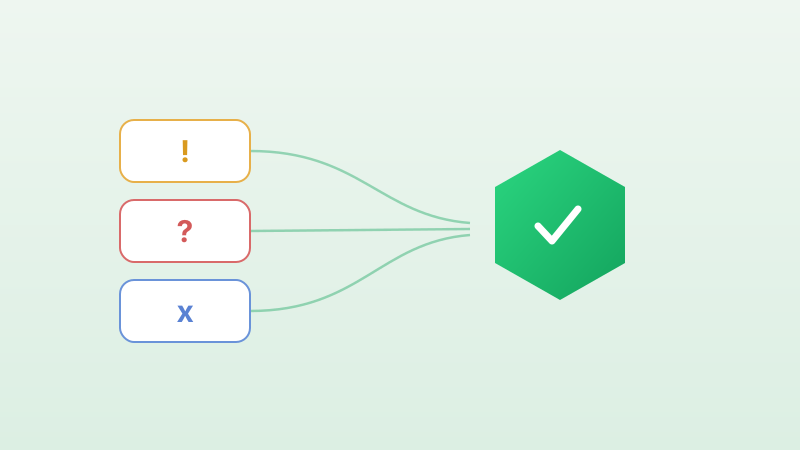
When an AI tool receives a query, it searches across all of these sources. If two sources disagree, the AI has to choose one, and it has no reliable way to know which is more recent or authoritative. So it picks one, sometimes at random. That's where inconsistency comes from.
The three root causes
- Duplicate content: The same information exists in multiple places with slightly different wording or outdated values.
- No versioning: When content is updated, the old version isn't removed. The AI sees both and has no way to know which is current.
- No single source of truth: There's no authoritative place where the 'correct' version of each piece of knowledge lives.
The fix: centralise, then connect
The pattern that consistently eliminates inconsistency is simple in concept: maintain one canonical version of each piece of knowledge, and have every AI tool read from that single source.
This is exactly what Khub is designed for. Instead of spreading knowledge across PDFs, Docs, spreadsheets, and inline prompts, you write each piece of knowledge once in Khub. Every tool that needs that knowledge queries Khub's search API. When something changes, you update it in one place and every tool reflects the change immediately.
Why search quality matters
Centralising knowledge is necessary but not sufficient. If the search that retrieves knowledge is poor, the AI will still get wrong answers, not because the knowledge is wrong, but because the search returned the wrong piece of knowledge.
This is why Khub uses hybrid search (keyword + semantic) with re-ranking. Pure keyword search misses semantic matches ('What's the cost?' won't match an item titled 'Pricing'). Pure semantic search misses exact matches ('SKU-4092' needs keyword precision). Combining both and re-ranking the results ensures the most relevant item surfaces first.
A practical checklist
- Audit your AI tools: list every source each tool reads from. Flag duplicates.
- Pick a single source of truth: Khub, a wiki, a CMS, whatever you choose, commit to it as the canonical source.
- Remove competing sources: delete or disconnect the old PDFs, Docs, and spreadsheets that AI was reading from.
- Set up a review cadence: check your knowledge base monthly for stale content. Khub's version history makes this easy to track.
- Test: after each change, ask your AI the relevant question and verify the response matches the updated knowledge.
The goal isn't to train better AI models. The goal is to give existing AI models better data. Fix the knowledge layer and the AI fixes itself.