Knowledge architecture: structuring your Khub for maximum AI accuracy
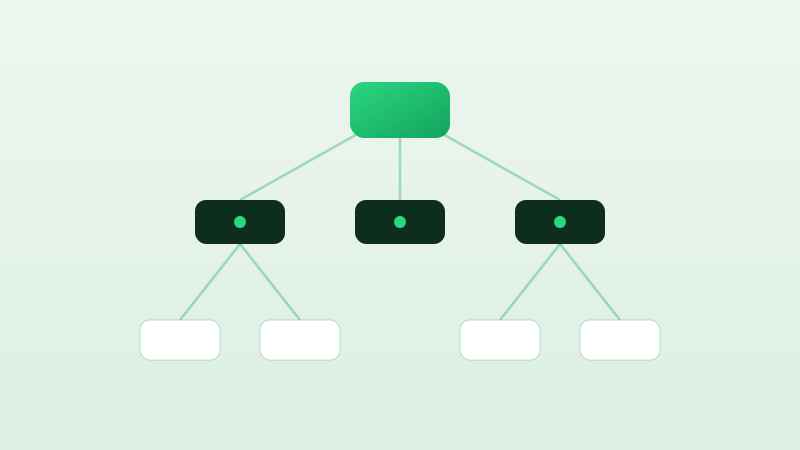
Most people think AI accuracy is about the model. GPT-4 vs. Claude vs. Gemini, temperature settings, prompt engineering. Those things matter. But in our experience working with hundreds of Khub users, the single biggest determinant of AI response quality is how the underlying knowledge is structured.
A well-structured knowledge base produces accurate, specific, trustworthy AI responses. A poorly structured one produces hallucinations, vague answers, and inconsistencies, regardless of which AI model you're using.
The three layers of knowledge architecture
We think about knowledge architecture in three layers. Get all three right and your AI accuracy improves dramatically.
Layer 1: Domain structure
This is how you organise knowledge into categories. Khub provides predefined domain sections, Products and Services, FAQs, Brand Voice, Booking Rules, Lead Routing, and more, because most businesses need the same categories.
The key principle: each piece of knowledge should live in exactly one section. If a fact appears in two places, they'll eventually diverge, and the AI will find both and get confused.
- Products and Services: What you sell, including pricing, features, and availability.
- FAQs: Direct answers to the questions customers actually ask.
- Brand Voice: How your AI should sound, tone, vocabulary, personality guidelines.
- Booking Rules: Availability, prerequisites, intake requirements.
- Lead Routing: Qualification criteria, handoff rules, response SLAs.
- Behaviour Rules: Constraints and escalation triggers for AI responses.
If you're not sure which section something belongs in, ask: 'What type of question would this answer?' A pricing question maps to Products and Services. A 'how do I book' question maps to Booking Rules. A 'what's your tone' directive maps to Brand Voice.
Layer 2: Item granularity
Each knowledge item should cover one concept, one product, or one question. This is counter-intuitive, it feels more efficient to write a single item covering 'All our pricing', but it makes search dramatically worse.
When a customer asks 'How much does the Pro plan cost?', you want the search to return a single, focused item about Pro plan pricing, not a 500-word document that covers all five plans. The more focused each item is, the more precisely the search can match it to a specific query.
- Bad: 'Pricing', one item covering all plans, discounts, and billing FAQs.
- Good: 'Pro plan pricing', one item per plan. 'Do you offer discounts?', separate FAQ. 'How does billing work?', separate FAQ.
Layer 3: Content quality
Within each item, the content needs to be written for machine consumption as much as human consumption. This doesn't mean writing in a robotic way, it means being specific, concrete, and unambiguous.
- Use exact numbers instead of vague ranges ('£49/month' not 'affordable pricing').
- Include timeframes ('48 hours' not 'promptly').
- State exceptions explicitly ('Excludes custom orders' not 'some conditions may apply').
- Include URLs so AI can direct customers to specific pages.
- Write titles as natural language questions when possible (for FAQs) or clear labels (for products).
The coverage score
Khub's IQ Strength indicator gives you a rough sense of coverage, but the real test is empirical. Take the 20 most common questions your customers ask and run each one through your AI tool. For each question, check:
- Did the AI find the right knowledge item?
- Was the response accurate and specific?
- Were there any hallucinated facts?
If any of those checks fail, the fix is almost always in the knowledge base: add a missing item, improve the title for better search matching, or make the content more specific.
Knowledge architecture is not a one-time task. Plan a 30-minute monthly review where you check for stale items, fill coverage gaps, and test queries. This single habit is the biggest predictor of sustained AI quality.